



In the article
Last Updated on 30/12/2025 by Tony Abrahams
Bed bugs on aeroplanes sound like one of those travel horror stories people tell just to stress you out. But they’re real. Not on every flight, not all the time, but real enough that airlines quietly deal with them behind the scenes.
In this guide, we’ll walk through the five big questions: why, how, when, where and what. Then we’ll look at what you can actually do so one stray bug on a long-haul flight doesn’t become a full-blown infestation in your bedroom.
TL;DR: Bed Bugs On Aeroplanes
TL;DR: Bed bugs can end up on aeroplanes because passengers unknowingly carry them in luggage and clothing. Once on board, they hide in seat seams, carpets and cracks, then hitchhike off the plane into hotels and homes. Bites often show up hours or days after the flight, so most people never connect it to the plane. The real risk isn’t the flight itself, but a single hitchhiker starting an infestation at home
The safest move when you get back is to treat luggage as “contaminated”, hot-wash and heat-dry clothes, and use a DIY Isolation Method at home with mattress covers, Bed Bug Killer Powder, and Floor Bed Bug Barrier Traps so bed bugs can’t reach you in bed.
Why are there bed bugs on aeroplanes?
Bed bugs on aeroplanes are becoming more common
Short answer: people bring them on board.
Bed bugs don’t naturally “live” in aeroplanes. They’re hitchhikers. They hide in:
- Suitcases and carry-on bags
- Backpacks and laptop bags
- Coats, jumpers, and travel pillows
- Seams and folds of clothing
Once they’re on the aircraft, a bed bug can crawl from luggage into a seat seam, carpet edge, or seat pocket and sit there until the next warm body shows up. Because planes turn around quickly and cleaning is often surface-level, a few bugs can slip through unless there’s a clear complaint.
In other words, it’s not that airlines are filthy. It’s that bed bugs are very good at hiding, very good at hitchhiking, and very patient.
More Info About What Are Bed Bugs?
How do bed bugs get onto the plane?
Here’s the usual chain of events:
- Someone stays in a hotel, hostel, Airbnb, or home that already has bed bugs.
- A few bed bugs crawl into their suitcase, backpack, or clothing.
- That luggage goes to the airport and sits with hundreds of other bags.
- Bed bugs stay in that bag or wander into neighbouring luggage.
- The passenger boards the flight with that luggage.
- The bed bug explores the seat area and finds a new hiding place.
They’re not targeting aeroplanes specifically. They’re simply following their food and hiding spots. We just happen to be the food.
When are you most at risk of bed bugs on aeroplanes?
Bed bugs don’t keep a strict “season” the way mosquitoes do, but the risk of exposure can increase when:
- Travel volume is high (school holidays, summer, Christmas/New Year).
- Long-haul flights are completely full and people are packed in.
- You’ve just stayed somewhere that already had bed bugs (even if you didn’t realise at the time).
- You’re flying overnight and sleeping for long stretches.
- You’re sitting in older, cloth-covered seats instead of leather or vinyl.
Bed bugs prefer to feed when you’re still. So overnight flights where you’re asleep for eight to fourteen hours can be slightly higher risk than a short daytime hop where you’re moving around and awake.
Where do bed bugs on aeroplanes hide?
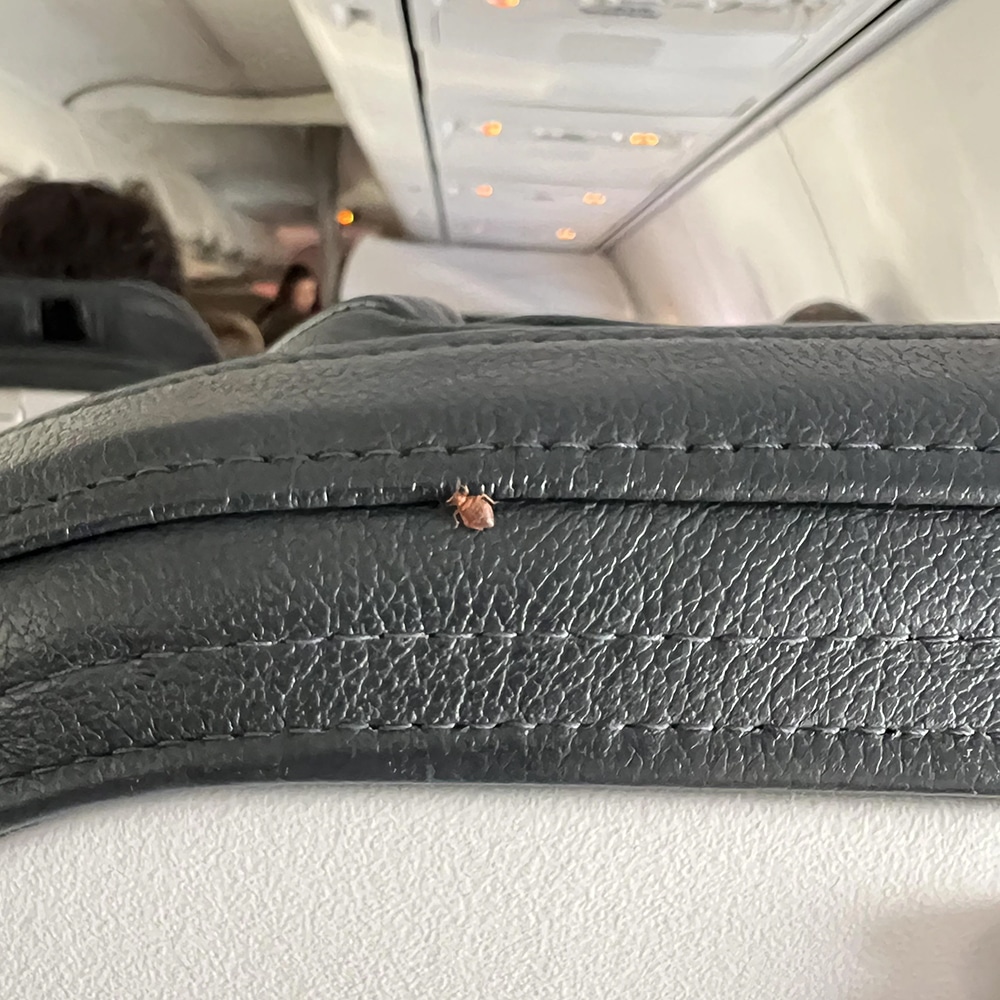
Bed bug hiding in aeroplane seat seam
Bed bugs love tight, dark crevices. On aeroplanes, that usually means:
- Seat seams and stitching
- Fabric piping and folds
- Under or behind seat cushions
- Carpet edges and joins
- Inside seat pockets
- Cracks near armrests and sidewalls
They are not living in engines, cockpits or overhead bins as a general rule. They’re close to people, where the blood meals are. If there’s fabric and cracks near where you sit or sleep, that’s their prime real estate.
Where Do Bed Bugs Hide At Home?
What happens if you get bitten by bed bugs on an aeroplane?
Here’s the tricky part: you often don’t notice until later.
Bed bug bites can appear:
- Overnight after the flight
- The next day
- Sometimes 2–3 days later
So you wake up at your hotel covered in bites and blame the hotel. Or you get home and assume the problem started in your bedroom. Meanwhile, the original exposure might have been on the plane, in the airport, or at a previous stop.
Typical bed bug bite signs include:
- Clusters or lines of red, itchy bumps
- Local swelling and irritation
- Itching that often feels worse at night
Some people don’t react at all, even when they’re being bitten. That makes it even easier for bed bugs to move around undetected.
Bed Bug Bites in Australia: How to Find, Treat and Prevent Bed Bugs Fast
Can bed bugs on aeroplanes spread to your home?
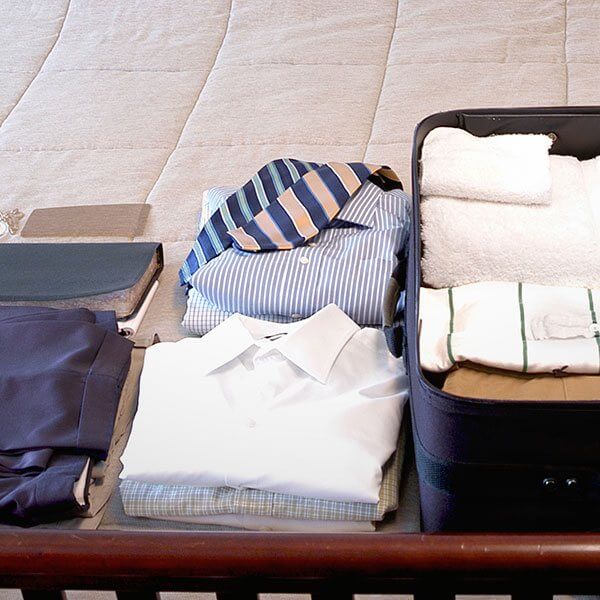
Yes, and this is the main problem.
You don’t need a plane full of bed bugs to have an issue. One pregnant female hiding in your luggage can start a whole population once she’s back in your bedroom.
Think of the plane as a transfer station. The real infestation usually starts later, in:
- Hotels and holiday rentals
- Your bedroom at home
- Guest rooms and spare beds
This is why what you do after the flight matters more than panicking during the flight.
What should you do after flying so bed bugs on aeroplanes don’t follow you home?
Here’s a simple post-travel routine to minimise the risk that a hitchhiker turns into a full infestation:
1. Keep luggage off the bed
When you get home, resist the urge to drop your suitcase on the bed and start unpacking.
Instead, place luggage on a hard floor so you can see what you’re doing and any bugs are easier to spot.
2. Use heat: it kills bed bugs and eggs
Bed bugs and their eggs die at sustained high temperatures. Where possible:
- Wash clothes on a hot cycle (check labels first).
- Dry clothes on high heat for at least 30 minutes.
Even if you don’t see anything, treating your travel clothing this way is a good habit.
3. Inspect your luggage
Check seams, folds, zips and corners of your suitcase or backpack for:
- Small dark spots (bed bug droppings)
- White or pale eggs or eggshells
- Shed skins or live bugs
A small torch or phone light makes a big difference.
4. Steam your suitcase
Steam the inside and outside of the case, especially the seams and corners with a handheld steamer.
5. At home, use a DIY Isolation Method
This is where you protect your bed so that even if a single bed bug has made it home with you, it can’t turn into a long-term infestation.
The Bed Bug Barrier Isolation Method focuses on three things:
- Seal the mattress with a bed bug proof mattress cover so bugs can’t hide inside it.
- Kill on contact and over time with steam and Bed Bug Killer Powder (amorphous silica) on the bed frame, ensemble base, and around bed legs.
- Block access to the bed with Floor Bed Bug Barrier Traps or screw-in barriers under each bed leg so bugs have to cross the powder and can’t climb up to bite you.
If you want to see the process step-by-step, watch our DIY videos for ensemble beds, bed frames and couches here: DIY Bed Bug Treatment Instructions.
Once your bed is isolated, you can sleep in it that night knowing you’re not feeding any hitchhikers that might have come home after your flight.
Signs a bed bug may have come from your flight
You might suspect the plane if:
- Bites start soon after a long-haul flight.
- You didn’t stay anywhere before the flight where bed bugs are likely.
- You noticed small insects or black spots on or around the seat.
- Cabin crew moved you from your seat because of “insects” or “bugs”.
- Another passenger nearby complained of similar bites.
You’ll rarely know with 100% certainty. Bed bugs don’t come with a boarding pass. But if the timing lines up with your flight, treat your luggage and your bed as if they’ve had contact. It’s easier to prevent than to fix later.
What do airlines do about bed bugs on aeroplanes?
Most airlines will, at a minimum:
- Move the affected passenger to another seat.
- Take the affected seats out of service temporarily.
- Arrange targeted treatment and deep cleaning of the area.
They don’t fog or fumigate entire planes after every single report; that would shut down fleets. Instead, they deal with specific cases and rely on normal cleaning plus targeted intervention.
That’s another reason why it’s smart to protect yourself on the home side. You can’t control what happens on the plane, but you can absolutely control what happens to your luggage and your bed after you land.
How the Bed Bug Barrier system helps frequent travellers

Bed Bug Barrier Isolation System
If you travel regularly for work or holidays, you’re exposed more often. You don’t need to be paranoid, but you do want a simple system that doesn’t rely on chemicals every time you come home.
The Bed Bug Barrier Isolation Method gives you:
- Instant kill using steam on bed frames and cracks (ideal if you’re already reacting to bites).
- Long-term protection with our APVMA-approved Bed Bug Killer Powder.
- Physical barriers with Floor Bed Bug Barrier Traps under the bed legs, so bed bugs can’t climb up to feed.
- Mattress and base covers that trap existing bugs and stop future hiding places.
Apply it once correctly, and you can sleep in the room that same night while the system keeps working in the background for years. No repeat call-outs, no toxic sprays around your family, and far less stress every time you step off a flight.
FAQs about bed bugs on aeroplanes
Can you actually catch bed bugs on a plane?
Yes, but not in the same way you “catch” a cold. Bed bugs don’t jump or fly. They hide in fabric and cracks. If a bug is in a seat or on another passenger’s luggage, it can crawl onto your clothing or bag, then travel with you to your next stop. The plane is just part of the journey.
How do I know if my bites came from the flight or the hotel?
Honestly, you often can’t be sure. Bites can take hours or days to appear. If you only started getting bites after a long flight and had no issues at home beforehand, the exposure could have been in the airport, on the plane, or at the hotel. That’s why it’s smart to treat your luggage carefully and isolate your bed as soon as possible, no matter where you think it started.
Should I complain to the airline if I think there were bed bugs on my seat?
Yes. Quietly let cabin crew know if you see bugs, black spotting, or you’re being bitten. They can move you, and it also flags the seat for inspection and treatment later. It’s in everyone’s interest that they know, even if it feels awkward at the time.
Can I stop bed bugs from getting into my house after a flight?
You can’t control everything, but you can massively reduce the risk. Keep luggage off the bed, hot-wash and heat-dry clothes, inspect and vacuum your bags, and set up a DIY Isolation Method in your bedroom. With mattress covers, Bed Bug Killer Powder and bed leg barriers in place, even if one bug did come home with you, it won’t turn into a full infestation.
Do I need professional pest control if I think bed bugs followed me home?
Not always. Many people in homes, units, and even small accommodation businesses manage bed bugs successfully with a DIY system. Using steam, long-lasting powder, mattress encasements and Bed Bug Barrier traps, you can isolate beds and kill bed bugs over time without toxic chemicals or repeat call-outs. If you’re overwhelmed, have multiple infested rooms, or can’t physically carry out the steps, professional help plus a barrier system is a good combination.
If you’ve found this guide on Bed Bugs On Aeroplanes helpful and want to protect your bedroom before or after a trip, you can watch our DIY videos here: DIY Bed Bug Instructions for Ensemble Beds, Bed Frames and Couches.
Watch Our DIY Videos: Control Bed Bugs With The Isolation Method
Are you looking for an organic DIY treatment?
These step-by-step videos show you exactly how to use the Isolation Method on different types of beds.
For an Ensemble Bed
For a Bed with Slats
Sources: Bed Bugs On Aeroplanes
- Centers for Disease Control and Prevention – About Bed Bugs & Travel Risk
- US Environmental Protection Agency – Bed Bug Tips for Travel
- Mayo Clinic – Bedbugs: Symptoms, Causes and Spread via Luggage

Tony pioneered a non-toxic, eco-friendly solution for bedbug infestations. His innovation won the ABC TV show “The New Inventors” in 2009. In 2012, he successfully registered Diatomaceous Earth for bedbug control in Australia.





Leave a Reply